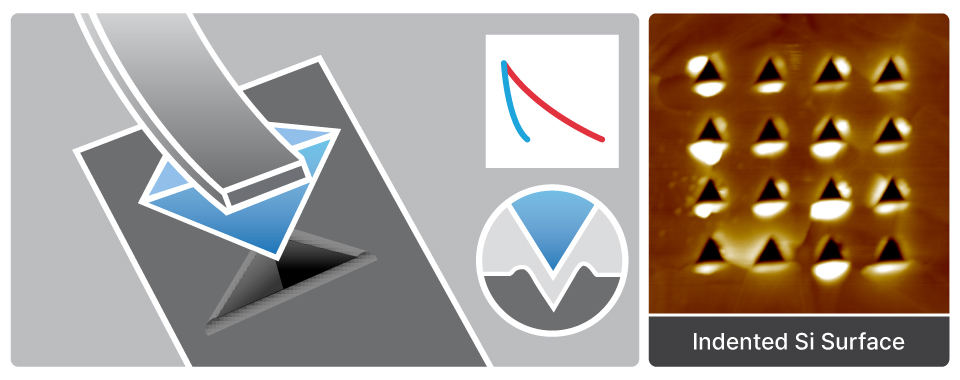
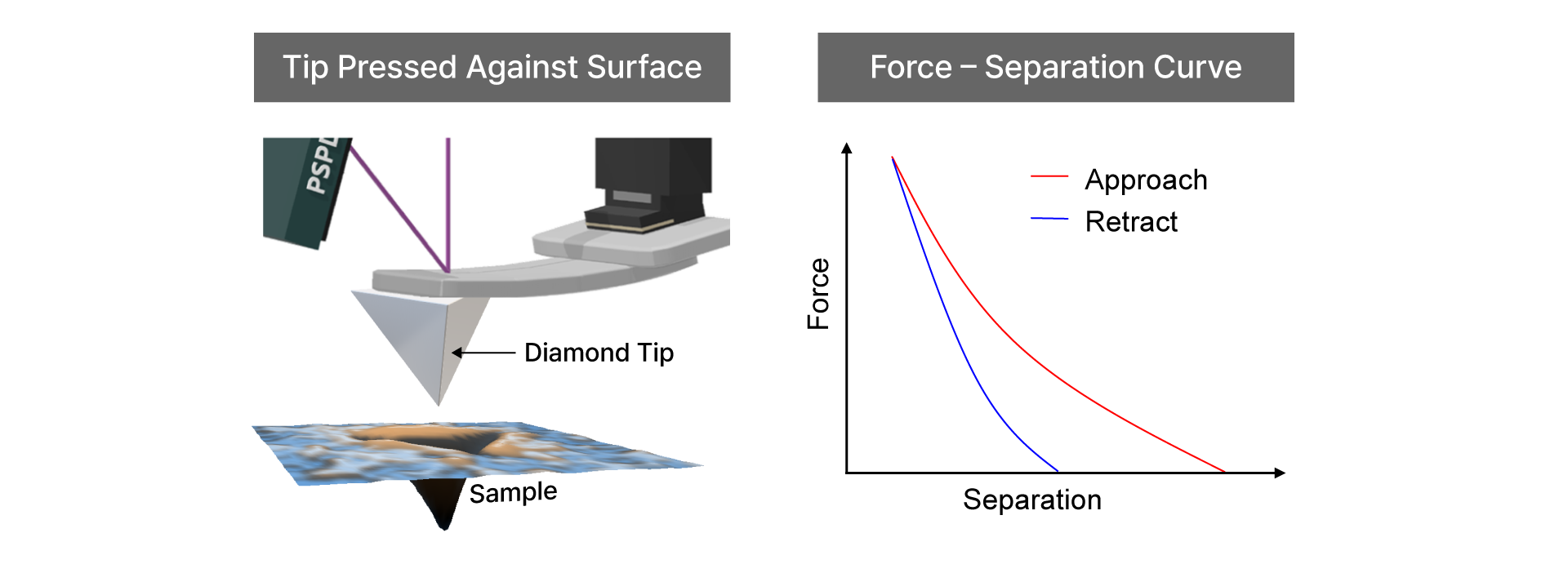
Nanoindentation measures hardness and Young's modulus by precisely indenting the sample surface with a sharp and rigid tip while recording the load and penetration depth.
A stiff AFM cantilever equipped with a diamond tip contacts the sample in a controlled manner while the applied force and resulting indentation depth are recorded. This process generates a force–separation curve from which Young’s modulus and hardness (The resistance to permanent deformation) can be calculated, most commonly using the Oliver–Pharr model.
Compared to force–distance spectroscopy, nanoindentation is designed for elastic–plastic characterization of harder materials, ensuring higher load accuracy and repeatability. Accurate calibration of the force slope, A–B sensitivity, and spring constant are required to ensure reliable mechanical property measurements.
Reasons to Use This Mode
Nanoindentation is similar to Force-distance (F/d) spectroscopy, but different. F/d spectroscopy primarily focuses on measuring short-range forces or adhesion, and it is limited in depth control, making it unsuitable for the precise plastic deformation analysis required for complex contact mechanics. Nanoindentation, conversely, is a specialized application of F/d spectroscopy that utilizes precisely controlled load application and advanced analysis protocols. Its main advantage is the ability to directly quantify modulus and hardness by analyzing the retract data of the force-separation curve using established theories like the Oliver-Pharr Method. This technique is specifically designed to characterize both the elastic and plastic deformation regimes of the material, enabling the measurement of hardness.
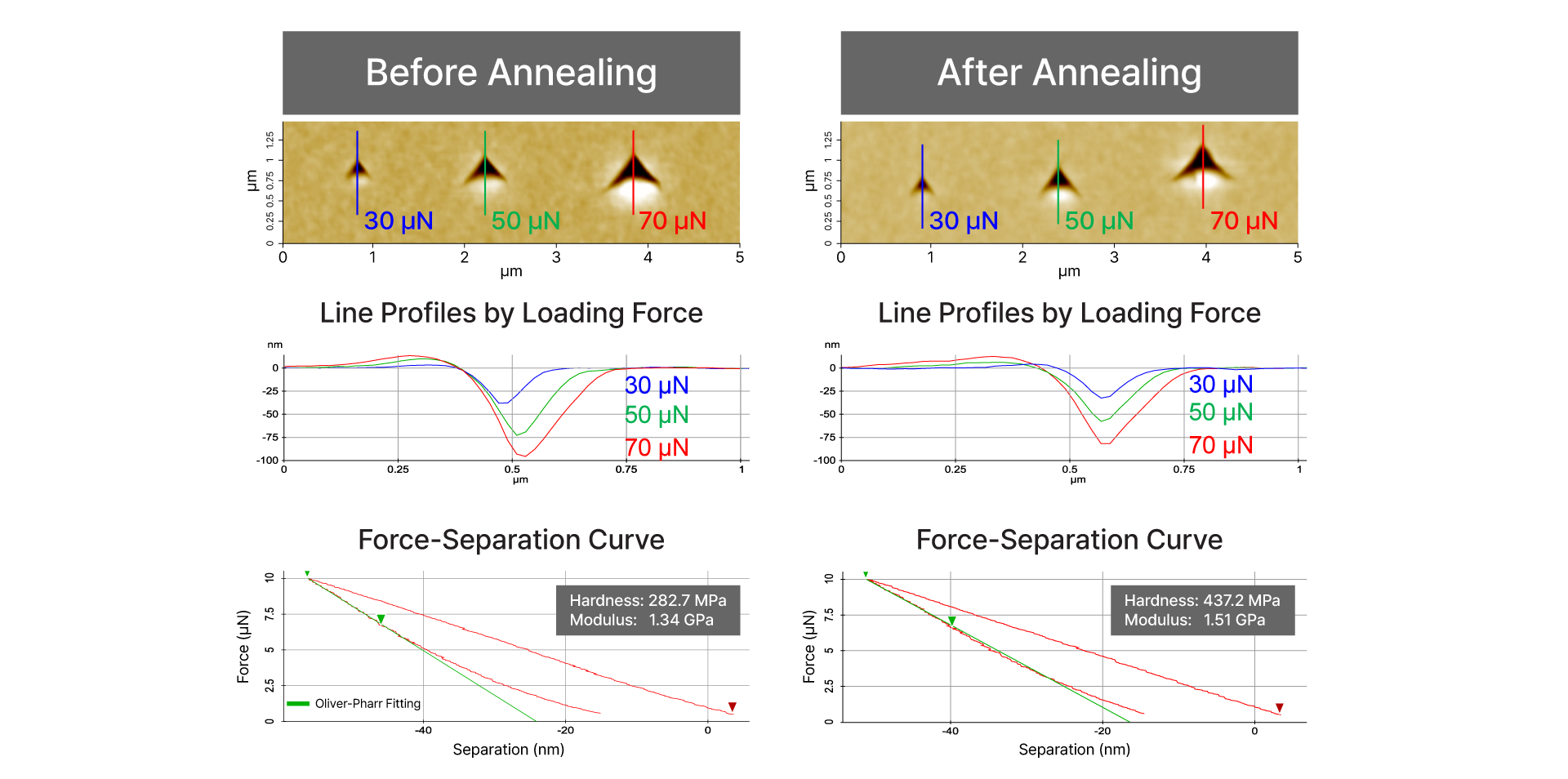
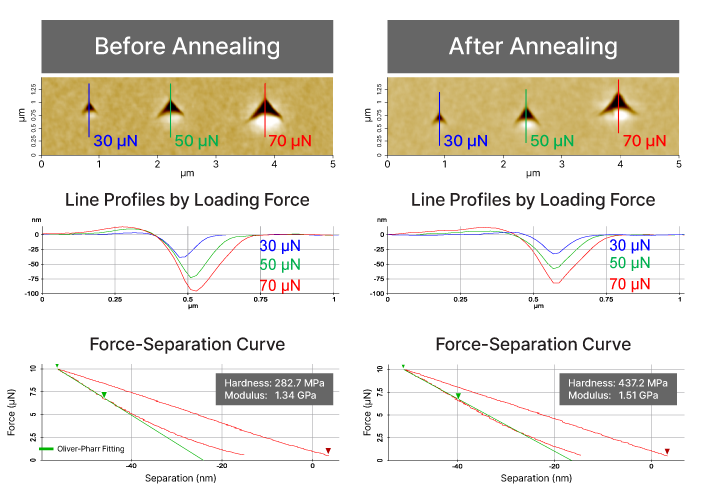
Results illustrate Nanoindentation to study the mechanical properties of carbon-doped hydrogenated silicon oxide (SiOCH) films before and after annealing. Surface profiles and force-separation curves were obtained at various loading forces, allowing precise quantification of hardness and elastic modulus. The results reveal that annealing increases both hardness and modulus, demonstrating the sensitivity and effectiveness of nanoindentation for detecting subtle mechanical changes in thin-film materials.